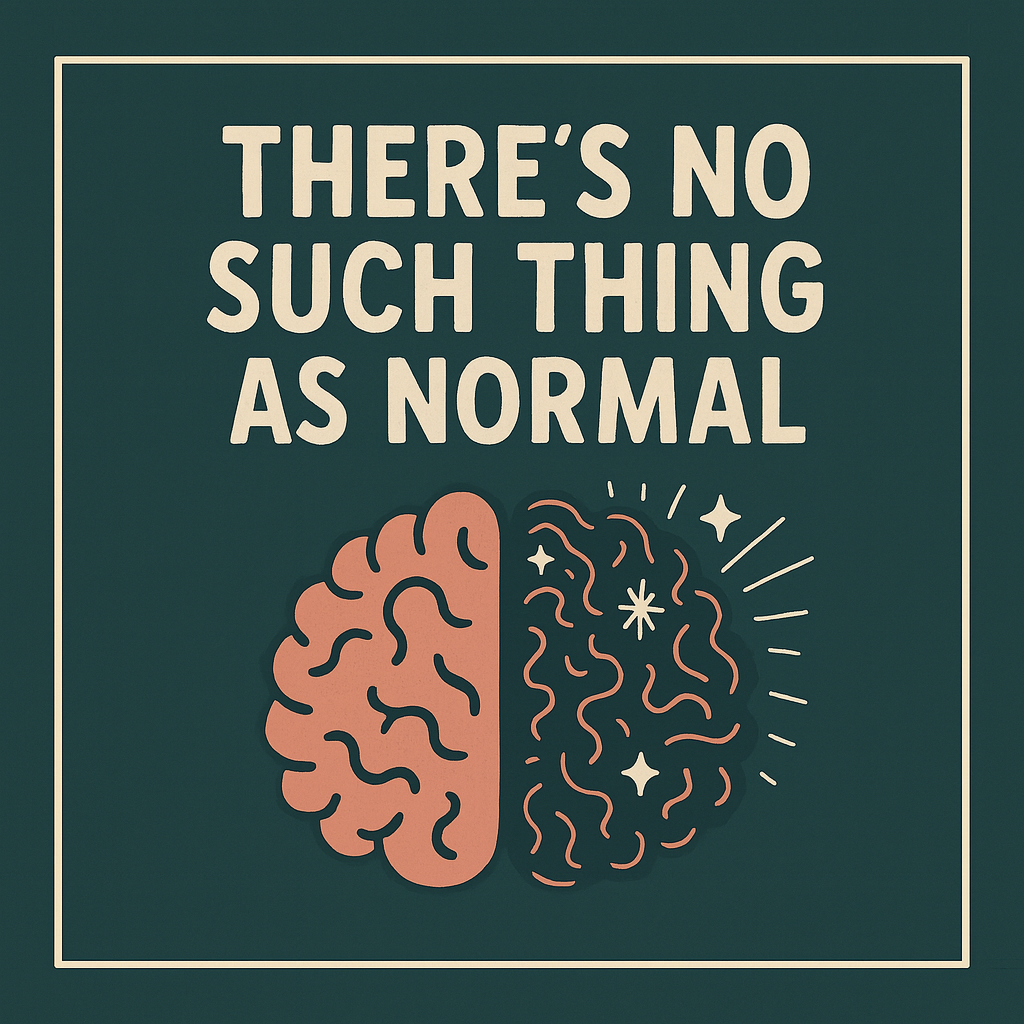

We often hear people say they “just want to feel normal again.” But what if that idea of “normal” is part of the problem? Mental health has no normal, and that’s not a flaw in the human condition; it’s a truth we’ve overlooked for too long. Mental and emotional experiences exist on a spectrum, and trying to force everyone into one narrow definition of stability or function can do more harm than good.
Every one of us carries our own blend of thoughts, patterns, fears, hopes, wiring, and, yes, imbalances. Every one of us has our own version of “crazy,” and I say that not to offend but to humanize.
The Brain Is Dynamic, Not Broken
Your brain is not a static machine. It’s a living, adapting organ, shaped constantly by genetics, experience, and environment. Neuroplasticity, the brain’s ability to rewire itself, is the reason people can heal from trauma, learn new ways of coping, and respond to therapy or medication. It’s also the reason people sometimes get stuck in loops of fear, anxiety, or sadness.
In other words, our mental states aren’t fixed traits. They’re dynamic processes.
We All Have Our Stuff
Some people have more intense versions of common human experiences, like sadness that becomes depression, or worry that spirals into anxiety. Others experience hallucinations, mania, compulsions, or suicidal thinking. These are not moral failings or weaknesses. They’re signals that the brain is overwhelmed or operating differently, sometimes temporarily, sometimes long-term.
Adverse mental health is more common than most realize. The Wisconsin Youth Risk Behavior Survey (2023) showed that over half of high school students reported persistent feelings of anxiety, and more than a third reported depression. That’s not an exception; that’s a trend.
So instead of asking “What’s wrong with you?” we might do better asking, “What happened to you? What’s going on in your brain right now? How can we help it heal?”
Redefining Normal: From Judgment to Understanding
Calling people “crazy” or “broken” is both inaccurate and cruel. Instead, we should embrace the fact that brains vary just like bodies do. Everyone experiences stress responses. Emotional triggers are part of being human. Some of us lean on healthy coping strategies, while others fall into harmful patterns. And at one point or another, each of us feels overwhelmed. That doesn’t make anyone abnormal—it makes us human.
The more we understand the science behind mental health, the more we realize this: “normal” is not a real place, and chasing it often keeps people stuck in shame.
Instead, what if we chased balance? Resilience? Understanding?
A New Definition of Mental Health
Let’s define mental health not as the absence of struggle but as the presence of awareness, support, and tools to navigate the highs and lows. Let’s remind each other that having a diagnosis isn’t a label of dysfunction, it’s a guidepost for treatment. It’s a beginning, not an end.
Closing Thoughts
You are not your diagnosis. You are not your worst day, and you are not alone.
The more we talk about mental health as a shared human experience, not a dividing line between “normal” and “not,” the more space we create for healing, understanding, and belonging.
No one is completely “normal.” That’s more than okay, it’s what makes us beautifully human.