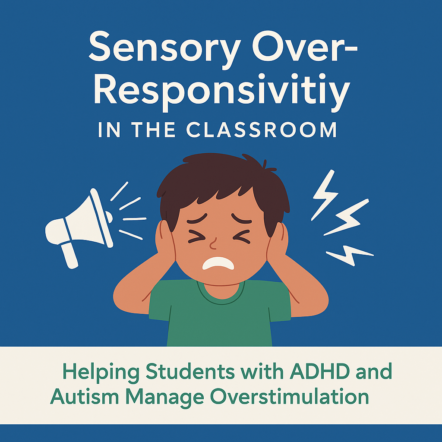

Sensory over-responsivity in the classroom occurs when everyday sights, sounds, and movement are flagged by a child’s nervous system as “too much, too fast, too close.” In busy school environments, cafeterias, assemblies, and echoey hallways arousal rises, filtering drops, and irritability or behavior issues often follow. This is especially common in students with ADHD and autism, where sensory processing differences make noise and visual clutter harder to manage. In this post, we unpack the science behind sensory over-responsivity, show why overstimulation builds throughout the school day, and offer evidence-informed ways to reduce load and restore access to learning. If you’ve ever watched a student hold it together until one more bell rings, this guide will help you spot triggers sooner and respond with supports that work.
What SOR looks like in schools
- Escalating anxiety/irritability in cafeterias, assemblies, bus lines, gym, and echoey hallways
- “Noncompliance” that’s actually escape/avoidance of overwhelming input
- Meltdowns after prolonged effort to cope, often worse late morning/afternoon
- Lower engagement when the visual environment is cluttered (too many wall displays competing with instruction) PMC
How it works under the hood (plain-English science)
Leaky sensory gating. Many autistic and ADHD profiles show weaker “sensory gating,” so repeated or irrelevant inputs aren’t filtered efficiently. Each clang still lands like the first. (Think: the brain’s volume knob is stuck.) Studies using P50 suppression and related paradigms document this gating issue. Result: more raw input → more arousal → more irritability. [gating/P50 evidence] PMC+1
Arousal system shift (LC-NE). With ongoing stimulation, the locus coeruleus–norepinephrine system drifts from a helpful phasic mode to a more tonic, always-on mode, attention becomes distractible, and top-down control weakens. Result: the longer the noise/visual load continues, the harder it is to self-regulate. [LC-NE theory] PubMed+2Annual Reviews+2
Downstream risk. Longitudinal research links early SOR with later anxiety and irritability, which is why these aren’t “just quirks”; they’re signals worth addressing early. [developmental risk] PMC+1
How common is this?
- Autism: Sensory hyper- or hyporeactivity is embedded in DSM-5 diagnostic criteria; it’s the rule, not the exception. CDC+1
- ADHD: Multiple studies report higher sensory processing problems and heightened sympathetic responses to sensory input compared with peers. PMC+1
Quick differential (so teams focus on the plan)
- SOR: broad sensitivity (volume, textures, crowds), relief in quieter/simpler spaces
- Misophonia: intense reaction to specific sounds (e.g., chewing)
- Phonophobia/migraine: sound sensitivity + headaches and/or light/smell sensitivity
- A primarily behavioral explanation fits poorly if distress drops rapidly once you adjust the environment
(These distinctions align with clinical and education literature on sensory differences and anxiety links.) PMC
Evidence-informed supports that help in classrooms
Soften the soundscape
- Add soft surfaces (rugs, felt pads), keep doors closed during transitions, and seat away from HVAC/doorways.
- Trial noise-attenuating or filtered ear defenders during known hot zones (assemblies, lunch lines). Small studies suggest reductions in sympathetic arousal and better task performance for some learners. PMC+2Clemson OPEN+2
Tame visual clutter
- Reduce competing wall displays near the teaching focus; keep at least one “clean wall” behind the instructor to lower visual noise and support attention. PMC
Predictability + a pressure-release valve
- Use visual schedules, warn before bells/fire drills, and establish a brief escape option (quiet corner or hall pass) to decompress before escalation.
- Chunk multi-step directions; pair verbal with visual; schedule “heaviest listening” when arousal (and meds, if applicable) are optimal. (Educator/parent reports consistently link predictability with improved participation.) ScienceDirect
Language you can use with caregivers & staff:
“This isn’t willful defiance; it’s a hyper-arousal response. When we lower sensory load or add predictable structure, behavior improves because the nervous system can stay in the learning zone.”
“We’re not ‘spoiling’ we’re right-sizing the environment so the child can meet the same goals.”
Sources & further reading
- CDC—Autism diagnostic framework (DSM-5 overview): sensory criteria and core domains. CDC
- DSM-5 sensory features in autism (review/PMC): why sensory criteria were added. PMC
- ADHD & sensory processing problems (review/PMC). PMC
- SOR as an early risk factor for anxiety (longitudinal/PMC). PMC
- Chronic irritability & sensory processing (PMC). PMC
- Locus coeruleus–NE arousal model (PubMed & Annual Review). PubMed+1
- P50 sensory gating background (PMC) & ADHD gating study (Elsevier abstract). PMC+1
- Classroom visual clutter impact (PMC). PMC
- Noise-attenuating headphones in ASD/hyperacusis (PMC). PMC
- AAP policy statement on sensory integration therapies (PDF). Pediatrics Online