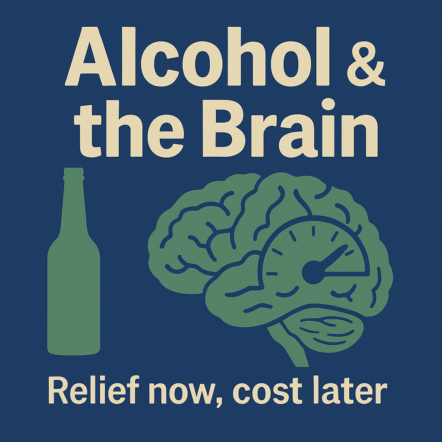

Many people wonder what’s really happening with Alcohol and the brain. In plain language, with real brain terms, this post explains why a drink can feel like instant relief, and why that feeling often fades.
The short version: alcohol turns down the alarm, then it turns up the bill
On contact, alcohol (ethanol) shifts how brain cells talk. The amygdala (your threat “alarm”) quiets, the prefrontal cortex (your planning “coach”) slows, and the mesolimbic dopamine system (your “reward bell,” including the ventral tegmental area and nucleus accumbens) rings. That mix brings quick ease, then a rebound: edginess, poor sleep, foggy focus. Relief first, cost later.
A calm, human look under the hood (with the real names)
1) The brain’s alarm quiets – Amygdala
Think of the amygdala as the alarm scanning for social threat and internal distress. Alcohol turns that alarm down for a while, so crowded rooms, conflict, or tight-chest feelings feel more manageable.
- Plain speak: less alarm = less tension, fewer racing thoughts.
- Term to know: amygdala (threat detector) becomes less reactive to stress signals for a short window.
2) The brakes get heavier than the gas – prefrontal cortex
Your prefrontal cortex (PFC) is the brain’s brake/coach; it helps you pause, read the room, and choose wisely. Alcohol pushes on that brake in a clumsy way: you feel looser and less self-conscious, but judgment and impulse control slide.
- Plain speak: easier socializing; fuzzier decisions.
- Terms to know: dorsolateral PFC (planning/working memory) and ventromedial/orbitofrontal PFC (value, inhibition) slow down, so it’s easier to say or do the thing you’d normally hold.
3) The reward bell rings, VTA → nucleus accumbens (dopamine)
Alcohol briefly boosts dopamine from the ventral tegmental area (VTA) into the nucleus accumbens, your brain’s “that felt good, remember it” center. Endogenous opioid signaling also nudges that warm, buzzy feeling.
- Plain speak: the shortcut gets saved to favorites.
- Terms to know: mesolimbic pathway, dopamine, nucleus accumbens, endogenous opioids.
4) The volume mix changes, GABA and glutamate
Underneath, alcohol tilts the balance between the brain’s two main messengers:
- GABA (inhibition) acts like a soft blanket; alcohol enhances GABA_A receptors, so things feel calmer.
- Glutamate (excitation) is the brain’s gas pedal; alcohol dampens NMDA-type glutamate receptors, which is why memory can blur (“blackouts” at higher doses).
- Plain speak: more “calm blanket,” less “go juice.”
- Terms to know: GABA_A receptors, glutamate, NMDA receptors.
5) The stress system flickers, HPA axis
Even as you feel calmer, alcohol can nudge the hypothalamic–pituitary–adrenal (HPA) axis to release cortisol. In the moment, the GABA/reward changes dominate your experience; later, stress chemistry can come back to bite.
- Plain speak: you feel calm now, but stress hormones may boomerang.
- Terms to know: HPA axis, cortisol.
(Other players you may notice in life: the hippocampus (memory/contexts) and cerebellum (coordination) also feel alcohol’s touch, think wobbly balance, and fuzzy recall.)
Why the calm doesn’t last (the rebound)
If alcohol only turned down the amygdala, we’d be done. But there’s a second act shaped by those same systems.
- Mood: as alcohol wears off, the amygdala/alarm can feel edgier, and the reward system goes quiet, so mood dips.
- Sleep: alcohol can knock you out fast (more GABA), but it disrupts sleep architecture, more awakenings, and a 3 a.m. stare at the ceiling.
- Focus & memory: with NMDA dampened, memory formation is sloppier; next-day prefrontal “coaching” is sluggish.
- Body stress: HPA/cortisol shifts can leave you restless or irritable.
Translation: short, easier evening; longer, harder next day.
The loop: why self-medication makes sense (until it runs the show)
For real people under real stress, the sequence is compelling:
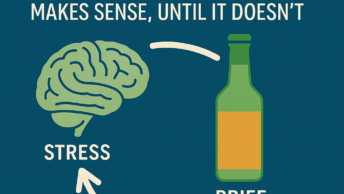
stress → drink → amygdala quiets + PFC slows + dopamine pops → relief → rebound → (back to stress)
Because relief shows up fast, the brain tags alcohol as an effective tool. With repetition, this becomes a habit loop in the corticostriatal circuits (PFC talking to the dorsal striatum), shifting from choice to routine.
- Plain speak: the shortcut becomes automatic.
- Terms to know: habit learning, corticostriatal circuits, dorsal striatum.
Costs you’ll feel before a lab test ever does
- Mood/energy: the “short fuse,” a gray next day, or feeling “not quite myself.”
- Sleep: quick knock-out, worse REM quality, early waking.
- Memory/focus: lost details, repeated stories, sluggish thinking (PFC/hippocampus effects).
- Relationships: missed cues, preventable conflict; isolation as a side effect.
- Self-talk: shame shows up, and shame cements the loop.
Gentle reframe: alcohol once solved a real problem; your brain learned quickly. Understanding, not blame, is step one.
When does “taking the edge off” become a problem?
Watch for small, stackable shifts:
- Drinking earlier or more often than planned.
- Building evenings around alcohol availability.
- Feeling irritable/restless when you don’t drink (amygdala rebound).
- Sleep is getting worse despite falling asleep faster.
- Loved ones notice changes in reliability or memory.
If several ring true, the shortcut may be running the show.
Culture matters (and this isn’t just willpower)
In many communities, alcohol is the social default. Bars can feel like a second living room; seeking help can feel stigmatized. That mismatch, alcohol celebrated, care whispered, pushes people toward the shortcut and away from support. Naming the environment reduces shame and opens choices.
A path forward from understanding, not shame
- Name the job. Was alcohol quieting the amygdala (anxiety), smoothing PFC social pressure (self-consciousness), or ringing dopamine (reward/comfort)?
- Name the rebound. Which costs show up for you: sleep, mood, focus, relationships?
- Get curious. If the habit loop is steering, what’s one small way to take the wheel back?
We’ll save specific strategies and treatments for a later series. For now, knowing how alcohol and the brain interact, the amygdala, the prefrontal cortex, the reward circuits, GABA, glutamate, and the HPA axis set the table for kinder, wiser decisions.
Share this with someone who might feel seen by it. If that someone is you, you’re not alone.
Further reading & resources
- NIAAA — Alcohol and the Brain: An Overview
https://www.niaaa.nih.gov/publications/alcohol-and-brain-overview - CDC — Alcohol and Public Health
https://www.cdc.gov/alcohol/index.html - Sleep Foundation — Alcohol and Sleep (how drinking changes sleep stages)
https://www.sleepfoundation.org/nutrition/alcohol-and-sleep