

Parenting a child with ADHD can feel like trying to explain a storm after it has already passed. You know something happened. You may even know it was intense. But when a provider, therapist, school, or daycare asks, “What are you seeing at home?” it can be hard to put the pattern into words.
As a parent of a child with ADHD, I feel that pain. I have been overwhelmed too. I know what it feels like to reach the end of the day and think, I know this was hard, but I do not even know where to start explaining it.
That is why learning how to track ADHD behavior patterns can be so helpful. Not because parents need one more thing to do, and not because every behavior needs to be documented perfectly. Tracking is useful because it helps turn scattered, stressful moments into clearer information.
The goal is not to blame the child. The goal is to understand what is happening so the adults around the child can respond with more clarity, consistency, and compassion.
Why ADHD Behavior Can Feel So Hard to Explain
ADHD is not just “too much energy” or “not listening.” ADHD can affect attention, impulse control, activity level, emotional regulation, frustration tolerance, transitions, and the ability to pause before acting. The CDC describes ADHD symptoms as patterns of inattention, hyperactivity, and impulsivity that can affect daily functioning in children.
In real life, that may look like:
- A meltdown after screen time ends
- Aggression during a transition
- Refusal when asked to stop a preferred activity
- Big emotions after being told “no”
- Irritability when hungry or tired
- Behavior getting worse at the same time every day
- More difficulty when medication may be wearing off
- Trouble calming down once the child is escalated
However, when you are living it, everything can blur together.
You may remember the screaming, the throwing, the refusal, or the unsafe behavior. But the useful pattern is often hidden in the details around the event:
- What happened before?
- What time of day was it?
- Was the child hungry?
- Did sleep go poorly the night before?
- Was there a transition?
- Was the expectation unclear?
- What helped the child recover?
- What made things worse?
Those details matter.
Tracking Is Not About Creating a Case Against the Child
This part is important.
Tracking behavior should never become a way to label a child as “bad,” “dramatic,” “manipulative,” or “defiant.” Those words may come from exhaustion, but they usually do not help anyone understand what is happening.
A better way to think about tracking is this:
Behavior tracking is a way to collect clues.
A trigger is not the same as blame. A pattern is not the same as an excuse. Understanding does not mean there are no limits.
Instead, pattern tracking helps adults ask better questions:
- Is this child struggling most during transitions?
- Is the behavior worse after poor sleep?
- Does hunger make escalation more likely?
- Is the child overwhelmed by noise, clothing, crowds, or changes in routine?
- Is the hardest part of the day predictable?
- Are expectations too long, too fast, or too verbal?
- Is there a possible medication timing pattern to discuss with the prescriber?
When adults understand the pattern, the child often benefits too. The child may get earlier support, clearer expectations, better routines, fewer avoidable escalations, and adults who are less reactive in the moment.
That helps everyone.
Start Small: Do Not Track Everything
One reason parents avoid tracking is that it feels like homework.
I get that.
When your house already feels stretched thin, the last thing you need is a complicated system that makes you feel like you are failing if you miss a day.
So start smaller.
You do not need to track every behavior. You do not need to write paragraphs. You do not need to complete every form every day.
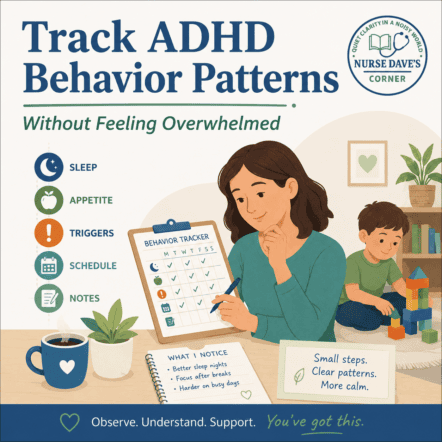
A simple starting point is tracking only five things for 3–5 days:
- Time of day
- What happened before the behavior
- What the behavior looked like
- What helped the child recover
- Sleep, appetite, or medication timing clues
That is enough to begin seeing patterns.
The best tracker is the one you will actually use.
What to Track First
If you are trying to track ADHD behavior patterns without getting overwhelmed, focus on the information most likely to help you, your child, and the support team.
1. Time of Day
Time matters.
Some children struggle most in the morning. Others fall apart after school or daycare. Some do well during the day but have a very hard time in the evening.
Common difficult times include:
- Wake-up and morning routine
- Before medication starts working
- School or daycare pickup
- Late afternoon
- Before dinner
- Bath time
- Bedtime
- After visits or schedule changes
Once you notice a time pattern, you can plan ahead instead of feeling surprised every day.
For example, if 5–7 PM is consistently hard, the problem may not be “bad behavior.” It may be fatigue, hunger, transition overload, medication wearing off, or too many demands packed into one part of the day.
2. What Happened Before
This is the “A” in an ABC behavior log.
ABC means:
- A = Antecedent: What happened before?
- B = Behavior: What did the child do?
- C = Consequence: What happened after?
The antecedent is often where the pattern begins.
Common antecedents include:
- Being told “no”
- Being asked to wait
- Stopping a preferred activity
- Screen time ending
- A transition
- A change in routine
- Hunger
- Fatigue
- Sensory overload
- Sibling conflict
- An unclear expectation
- Too many directions at once
This is not about blaming the parent, teacher, sibling, or child. It is about noticing what tends to happen right before escalation.
3. What the Behavior Looked Like
Try to write what you saw, not what you think it means.
Instead of:
“He was terrible all night.”
Try:
“He screamed for about 20 minutes after tablet time ended, threw one toy, and calmed after quiet space and a snack.”
Instead of:
“She was being manipulative.”
Try:
“She repeated the request for TV after being told no, cried, and followed the caregiver from room to room for about 10 minutes.”
Objective notes are more useful for providers, therapists, schools, and daycare. They also help you look back later without reliving the emotional weight of the moment.
4. What Helped
This is one of the most important parts of tracking.
Parents often remember what went wrong, but the “what helped” section may be the most useful part of the entire log.
Track strategies such as:
- Quiet space
- Reduced talking
- Calm voice
- Snack or drink
- Movement break
- Visual timer
- First/then statement
- Simple choices
- Sensory item
- Deep pressure or hug, if the child likes that
- Outside time
- Routine or visual schedule
When you find what helps, you are not just documenting problems. You are building a practical support plan.
5. Sleep, Appetite, and Body Clues
Behavior does not happen in a vacuum.
Poor sleep, hunger, illness, pain, constipation, allergies, overstimulation, and irregular routines can all make emotional regulation harder. The CDC notes that health problems such as poor sleep, hearing difficulty, or learning problems can cause or worsen behavioral or emotional symptoms.
For many children with ADHD, sleep and appetite patterns can be especially important to track.
Helpful questions include:
- Did the child sleep poorly last night?
- Was the child hard to wake?
- Did the child eat breakfast?
- Was lunch poor?
- Did behavior worsen before dinner?
- Did the child seem hungrier when medication wore off?
- Did a missed snack make escalation more likely?
This does not mean sleep or hunger explains everything. But these clues can help you prepare better and respond earlier.
How Pattern Tracking Helps the Child
It is easy to think tracking only helps adults.
But good tracking can help the child too.
When adults recognize patterns, they can often adjust the environment before the child reaches the red zone. That might mean offering a snack earlier, giving a transition warning, reducing verbal demands, planning movement breaks, adjusting routines, or bringing clearer observations to the child’s care team.
Pattern tracking can help a child by:
- Reducing repeated preventable triggers
- Helping adults respond earlier
- Making expectations clearer
- Supporting calmer routines
- Improving communication between home and school
- Helping providers understand what is happening outside the appointment
- Reducing shame by shifting the focus from “bad behavior” to “what is hard and what helps”
Children with ADHD are often corrected all day long. A pattern-based approach can help adults see more than the behavior. It can help them see the lagging skill, the body cue, the environmental stressor, or the support need underneath.
That is not lowering expectations. It is making support more targeted.
How Tracking Helps Parents and Caregivers
Tracking can help parents feel less stuck.
Instead of walking into an appointment saying, “Everything is awful,” you may be able to say:
“The hardest time is usually between 5 and 7 PM. The most common triggers are transitions, hunger, and stopping preferred activities. Reduced talking, snack, and quiet space seem to help. Sleep was poor on the hardest days.”
That kind of summary is powerful.
It gives providers, therapists, schools, and daycare something concrete to work with.
The CDC notes that ADHD care for children may include behavior therapy, parent training in behavior management, medication when appropriate, and school supports depending on the child’s age and needs. Clear observations from home can make those conversations more focused.
Tracking also helps parents separate patterns from guilt.
When you are overwhelmed, it is easy to think:
“I should have handled that better.”
Sometimes that may be true. We all have moments we wish we could redo.
But tracking may also show:
“This happens every day after school pickup when he is hungry, tired, and transitioning from a noisy environment.”
That is a different conversation. It moves the focus from guilt to problem-solving.
A Simple 7-Day Tracking Plan
If you want to start without overcomplicating it, try this:
Day 1: Track the basics
Write down the time of day, overall mood, sleep, appetite, and one sentence about the hardest moment.
Day 2: Watch for repeat timing
Did the hard behavior happen around the same time?
Day 3: Track one major event
If there is a meltdown or unsafe behavior, write what happened before, what the behavior looked like, and what happened after.
Day 4: Look for triggers
Check whether the pattern involves transitions, waiting, hunger, fatigue, sensory overload, or being told “no.”
Day 5: Track what helped
Pay special attention to what helped the child recover.
Day 6: Keep it light
Only track what feels useful. Do not let tracking become another stressor.
Day 7: Summarize the week
Choose the top 1–3 patterns you noticed.
You may be surprised how much useful information appears in just one week.
What to Bring to an Appointment or School Meeting
You usually do not need to bring every daily note.
A short summary is often more helpful.
Before a provider, therapist, school, or daycare meeting, try to summarize:
- Most difficult time of day
- Top 3 triggers
- Most common behaviors
- Sleep or appetite concerns
- Medication timing observations, if relevant
- What helped most
- Safety concerns
- Your top 1–3 questions
This gives the team a clearer starting point.
When to Ask for More Help
Tracking is useful, but it is not a replacement for support.
Consider contacting your child’s provider, therapist, school team, or care team if:
- Behavior is becoming more frequent or intense
- Aggression is increasing
- Your child is hurting themselves or others
- Your child is running away or creating unsafe situations
- Sleep or appetite changes are concerning
- Medication side effects are suspected
- School or daycare is reporting serious concerns
- Your family feels unable to manage behavior safely
Seek urgent help right away if there is immediate danger, serious injury, suicidal statements, severe aggression, hallucinations, or any medical emergency.
A Calm Reminder for Parents
You do not have to track perfectly.
You do not have to understand everything today.
You do not have to turn your home into a clinical chart.
Start with a few notes. Look for repeated clues. Notice what helps. Bring clearer information to the people supporting your child.
Difficult behavior does not mean your child is bad. It often means something is too hard, too fast, too much, too confusing, too frustrating, too stimulating, or too dysregulating in that moment.
When we track patterns calmly, we create a better chance of responding with the right support.
That helps the parent.
That helps the provider.
That helps the school or daycare.
Most importantly, it helps the child.
Printable Tool for Parents
If you want a ready-to-print option, I created the ADHD Behavior Tracker Printable Bundle for Parents through Nurse Dave’s Corner.
It includes:
- Start Here Guide
- Daily ADHD Home Behavior Log
- ABC Behavior Log
- Medication Effect Tracker
- Sleep and Appetite Tracker
- ADHD Behavior Trigger Checklist
- Weekly ADHD Behavior Pattern Summary
- Provider/School Handoff Sheet
The goal is simple: help parents notice patterns, organize observations, and communicate more clearly without making tracking feel overwhelming.
You can also add: