
If you’ve ever used Alcohol self medication to quiet anxiety, anger, or a heavy mood, you’re not alone, and you’re not broken. This post explains why a drink can feel like a smart, fast fix (at first), what the brain learns from that relief, and how the same shortcut can quietly become the main road.
The honest job alcohol is doing
When life turns up the pressure, the brain is hunting for a tool that works now. Alcohol happens to be fast, socially accepted, and easy to get. In the moment:
- The amygdala, your threat alarm, quiets down.
- The prefrontal cortex (PFC), your planning coach, slows its constant commentary, so you feel less self-conscious and on edge.
- The mesolimbic dopamine system (from the ventral tegmental area to the nucleus accumbens) rings the reward bell, tagging the experience as “effective.”
- Under the hood, alcohol nudges GABA_A receptors (more inhibition/calm) and dampens NMDA glutamate receptors (less excitation/memory formation).
- The HPA axis (stress system) may release cortisol, even while you feel calmer, an important detail for later.
Plain speak: in hard moments, alcohol really can make the room quieter and you lighter. Your brain notices, and remembers.
The loop you can actually feel
Here’s the typical sequence:
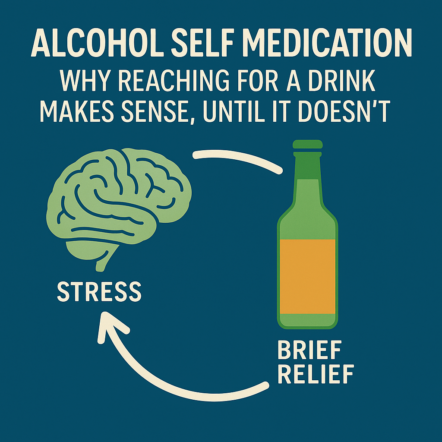
stress → drink → amygdala quiets + PFC slows + dopamine pops → short relief → rebound → more stress
- Short relief: easier conversation, softer worries, looser shoulders.
- Rebound: the amygdala wakes up edgier, the PFC feels foggy, sleep is choppy, and mood runs gray.
- Habit learning: with repetition, corticostriatal circuits (PFC ↔ dorsal striatum) wire a habit loop. The shortcut starts driving.
Key point: alcohol self medication is understandable. The problem isn’t that relief exists, it’s that the rebound and habit learning slowly take the wheel.
Why the shortcut gets sticky
- Speed is persuasive. When relief happens in minutes, the dopamine system stamps it “do this again.”
- Access + approval. In many places, it’s easier (and less stigmatized) to walk into a bar than to get same-week mental-health care.
- Memory fuzz. With NMDA dampened, your brain records fewer “this didn’t go so well” details, and more “that felt better” highlights.
- Cortisol boomerang. The HPA axis can leave you restless, irritable, or wired later, pushing another round.
- Shame trap. Feeling bad about drinking tends to increase tension, which ironically strengthens the urge to drink. Shame is jet fuel for the loop.
Signs the shortcut may be running the show
Not a diagnosis, just human signals to notice:
- You’re drinking earlier, more often, or more than you planned.
- Evenings are arranged around where/when you can drink.
- Irritability or restlessness shows up when you don’t drink (amygdala rebound).
- Sleep comes fast but fractures (3 a.m. awake, groggy mornings).
- Loved ones mention memory slips, a short fuse, or feeling “less connected” to you.
- Your private story is “I need this to feel normal.”
If several of these land, it doesn’t mean you’ve failed; it means the habit loop is well-practiced.
What loved ones should know
If someone you care about leans on alcohol self medication, they may be soothing real distress, not trying to cause harm. The amygdala relief is powerful; the rebound is sneaky; and shame tightens the knot. Compassion plus clear boundaries works better than lectures. (We’ll unpack conversations that help later in the series.)
Why “it makes sense, until it doesn’t”
- Makes sense: alcohol quickly dials down the amygdala, turns off the prefrontal cortex’s overthinking, and increases dopamine. In that moment, it solves the job: relieving your stress.
- Until it doesn’t: the price arrives later, edgy mood, fractured sleep, foggy focus, strained connection, and the only tool that seems to work again is… the same drink.
That’s the pivot point this series is building toward: not a lecture, but a clear view of the pattern so you can decide what comes next.
Your take-home in one calm paragraph
Alcohol self medication is a human response to human pain. It eases the amygdala alarm, quiets the prefrontal critic, and briefly lights dopamine’s reward bell, while quietly training a habit loop that asks for more tomorrow. Understanding that loop (relief → rebound → routine) is the first step out of shame and into choice.
Further reading & resources
- NIAAA – Rethinking Drinking (tools, worksheets, safe-drinking info). https://rethinkingdrinking.niaaa.nih.gov/
- NIAAA – The Brain in Addiction & Recovery (plain-language neuroscience of alcohol’s effects). https://www.niaaa.nih.gov/health-professionals-communities/core-resource-on-alcohol/neuroscience-brain-addiction-and-recovery
- MedlinePlus – Alcohol Use Disorder (symptoms, risks, diagnosis, and links to care). https://medlineplus.gov/alcoholusedisorderaud.html
- SAMHSA – Find Help (988, treatment locators, confidential support). https://www.samhsa.gov/find-help