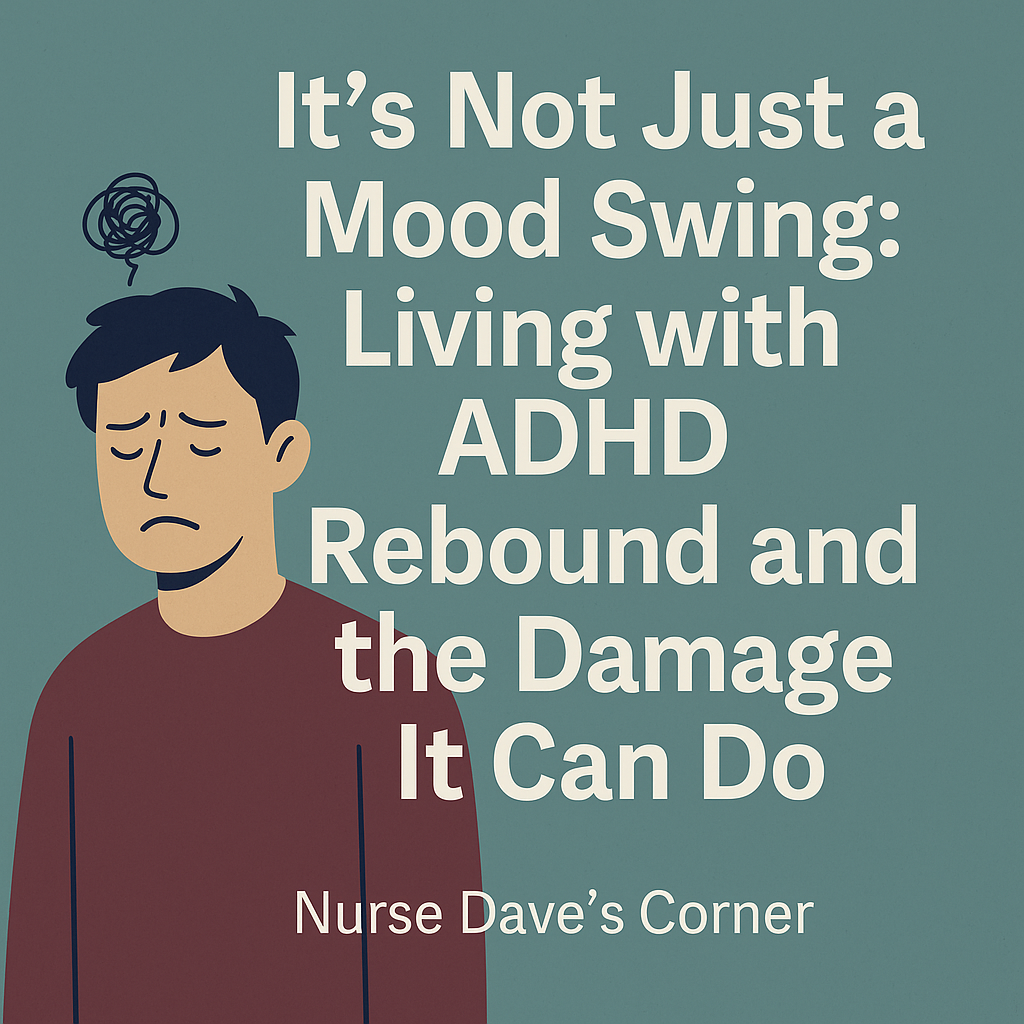

If you’ve ever felt like two different people in one day, calm and focused in the morning, then moody, tired, or even explosive by late afternoon, you’re not alone. For many adults with ADHD who take stimulant medications, this daily shift isn’t about personality or willpower. It’s called ADHD stimulant rebound, and it can wreak havoc on both your emotions and your relationships. The crash that happens when your medication wears off is more than a mood swing; it’s a neurochemical shift that can leave you feeling miserable, misunderstood, and isolated from the people who care about you.
Let’s talk about what this is, why it happens, and the silent toll it takes not just on those of us living with ADHD, but on the people who love us.
What Is Rebound, Really?
Stimulant rebound happens when ADHD medications, particularly short-acting or certain extended-release types, wear off and your brain chemistry shifts rapidly. For some people, this just means a return of the typical ADHD symptoms: distractibility, brain fog, and fidgeting. But for others, it feels like the floor drops out: irritability, sadness, anxiety, or even intense anger can surge in like a wave, often without warning.
It’s not uncommon for people to say things they don’t mean or withdraw entirely from those around them during a rebound episode. And afterward? Guilt, confusion, and self-doubt often follow close behind.
Rebound isn’t simply being “moody.” It’s a temporary but very real neurochemical crash. As stimulant levels drop, dopamine and norepinephrine, the neurotransmitters responsible for mood, motivation, and attention, decline sharply. It’s like flipping off a switch that had been holding everything in place all day (Huang et al., 2024; Wisor et al., 2001).
What It Feels Like (From the Inside Out)
Speaking personally, stimulant rebound feels like becoming someone else, someone more raw, more reactive, more tired, more overwhelmed. There’s a heaviness that settles over everything, and even small interactions can feel emotionally charged. A partner’s simple question might come across as criticism. A child’s normal energy feels unbearable. Tasks you were fine handling two hours ago suddenly seem impossible.
And the worst part? You know it’s happening, but in that moment, you can’t always stop it.
That’s why this isn’t a question of “trying harder” or “being more mindful.” This is your brain responding to a chemical shift, and the effects are as real as any other withdrawal symptom.
The Hidden Damage: Rebound and Relationships
What often goes unspoken is how rebound affects the people around us. Partners, friends, coworkers, and children may not understand why we’re suddenly “different” in the evening, or worse, they may take our mood personally. A spouse might feel pushed away. A child might internalize our irritability. A friend might assume we’ve lost interest.
Over time, these moments can create emotional distance, misunderstandings, or shame spirals. Relationships are built on trust and emotional safety. Rebound disrupts both, not out of malice, but because the person you love is suddenly overwhelmed and out of balance.
If this has happened in your life, you’re not alone. You’re not broken. And you’re not a bad partner, parent, or friend.
But we do need to name this for what it is, so we can begin to repair the harm, educate others, and build better systems of support.
“They Think I’m Being a Jerk… But I’m Miserable”
This is one of the most painful parts of rebound: the stigma. When someone sees your short temper or withdrawn mood but doesn’t understand what stimulant rebound is, they may label you as “moody,” “unstable,” or “mean.” And those labels hurt especially when you’re already feeling fragile inside.
But here’s the truth: You’re not being a jerk. You’re not emotionally weak. You’re not failing your loved ones.
You are experiencing a temporary neurochemical drop that can be managed with the right strategies and support.
What Can Help?
Here are a few science-backed tips that can make a big difference:
- Adjust the timing or formulation of your medication. Extended-release options or tailored booster doses in the afternoon can soften the transition and reduce rebound symptoms (Biederman et al., 2019).
- Plan for the crash. If you know you crash around 5:00 PM, build in 15–30 minutes of quiet downtime. Communicate with loved ones so they understand what’s happening.
- Practice self-compassion. Rebound isn’t your fault. Talk to yourself the way you would talk to a friend going through it.
- Let others in. Gently educate your partner, friends, or coworkers. Say something like: “Around 5 PM, my medication wears off and I can feel pretty raw or off. I promise it’s not you, I just need a little space or time to reset.”
Final Thoughts: Your Brain’s Not Broken, It’s Reacting
At Nurse Dave’s Corner, we believe in education over judgment. That means helping people understand that mental health challenges like stimulant rebound are not moral failings or character flaws. They’re often the predictable result of brain chemistry trying to regulate itself.
And when we name these things, when we understand them, we take the first step toward managing them and healing the small cracks they’ve caused in our lives.
If you’re struggling with rebound, I see you. I’ve been there. And I hope this post helps you feel just a little more understood.
References:
- Biederman, J., Fried, R., Hammerness, P., Surman, C., Petty, C., & Faraone, S. V. (2019). The effects of extended-release stimulants on comorbid symptoms in adults with ADHD. Journal of Attention Disorders, 23(2), 123–134. https://doi.org/10.1177/1087054715575066
- Huang, Y., et al. (2024). Neurotransmitter dynamics in stimulant rebound: A preclinical perspective. Frontiers in Neuroscience, 18, 1447688. https://doi.org/10.3389/fnins.2024.1447688
- Wisor, J. P., Nishino, S., Sora, I., Uhl, G. H., Mignot, E., & Edgar, D. M. (2001). Dopaminergic role in stimulant-induced wakefulness. Sleep, 24(9), 897–903.